

The Empty-Nest Career Question Nobody Warns You About
When family routines change, career questions can get louder. Here's how to use an empty-nest transition to notice what you want next without rushing it.
For years, the calendar answered a lot of questions for you.
School drop-offs. Games. College visits. Dinner at a reasonable hour if everyone was lucky. Work had to fit around a life that was already very full.
Then the house gets quieter.
And somewhere in that new space, a question that was easy to postpone gets much louder: if my time is becoming mine again, do I still want to spend it this way?
This is not only an empty-nest question
The same thing can happen after any major shift in responsibility. A child leaves home. A caregiving season changes. A partner retires. A demanding chapter of family life finally settles down.
For a long time, your career decisions may have been shaped by stability, benefits, location, or simply what the family needed from you. Those were real priorities. They may have been exactly the right ones.
The problem is assuming they have to remain your priorities forever.
More freedom can feel strangely uncomfortable
People imagine that having more choice will immediately feel exciting.
Often it feels disorienting first.
When you have spent years making decisions around other people's schedules, asking what you want can feel almost self-indulgent. And if the job is still objectively good, the question gets even harder. Nothing is wrong enough to force a change.
You just have more room to notice what is no longer right.
Do not fill the space too quickly
The instinct is to replace one full calendar with another. Take on the extra project. Join three committees. Say yes to the role because someone finally has time to do it.
Before you refill the space, leave some of it open long enough to learn from it.
Notice what you choose when nobody needs the hour from you. Notice the conversations you seek out. Notice what you read about when there is no practical reason to read about it.
Ask what this season makes possible
A useful next-chapter question is not “What should I do now?” It is “What is possible now that was not possible five years ago?”
Maybe travel is easier. Maybe a lower salary is workable. Maybe you can take a class on a Tuesday afternoon. Maybe you finally have the bandwidth to build something slowly on the side instead of demanding that it replace your income immediately.
The life change does not hand you a career answer. It changes the constraints around the answer.
Build from the life you have now
Chapter 3 is not about pretending the previous chapters did not matter. It is about noticing that the conditions have changed and giving yourself permission to make a new decision with new information.
Inside the Clarity Program, we look at more than skills and job titles. We look at the life you want the work to fit inside, because a next chapter that ignores the rest of your life is not much of a next chapter at all.
So, if your time is starting to open up, what do you want to be careful not to fill it with automatically?

Your Resume Is Not the First Thing to Fix When You're Considering a Career Change After 50
Before rewriting your resume for a career change after 50, get clear on the story it needs to tell and the direction you want it to support.
The resume is usually the first document people open when they decide they might be ready for something new.
New template. Tighter bullets. Better verbs. Maybe an AI tool to make twenty years of experience fit neatly onto two pages.
It feels productive because you can see the progress happening on the screen.
But if you are considering a career change after 50 and you do not yet know what you want the resume to point toward, polishing it is often just a very organized way to stay stuck.
A resume can only tell the story you give it
Most experienced professionals have enough material. That is not the problem.
The problem is deciding which parts of a long career belong in the foreground now. If you spent twenty years in operations but the work that still energizes you is mentoring leaders, building teams, or solving messy problems across functions, a traditional chronological resume may keep shouting the old story while you are trying to move toward a new one.
The document cannot make that decision for you.
Start with the sentence you want someone else to repeat
Before you touch the resume, imagine a former colleague introducing you to someone useful.
What do you want them to say?
Not your title. Not the company you worked for longest. The useful sentence.
“She is brilliant at helping small teams build structure without turning into a bureaucracy.”
“He has spent years translating complicated technology into decisions executives can actually make.”
That sentence is much closer to your next professional story than a list of responsibilities.
Then look backward for proof
Once you know the story you are trying to tell, your past becomes easier to edit.
You are not erasing experience that no longer fits. You are choosing the evidence that supports where you are going.
A project from twelve years ago may suddenly matter more than your most recent title because it proves a capability you want to use again. A volunteer role may belong in the conversation because it shows the kind of work you want more of. A leadership accomplishment may need to be rewritten around the problem you solved, not the size of the team you managed.
Your network needs the new story too
A beautifully rewritten resume does very little if everyone who knows you still describes you the old way.
This is why career change after 50 is partly a language problem. You need to practice saying what you are moving toward before it feels completely natural, so the people around you have a chance to update their picture of you.
That can start in one coffee conversation long before it becomes a LinkedIn announcement.
Fix the direction before the document
There will absolutely be a time to update the resume. When you know what you are aiming at, AI can be useful—not simply for making your bullets sound better, but for helping you reposition the experience you already have around where you want to go next.
That is why Find My Chapter 3 offers a free Resume Repositioning Assistant, designed to help experienced professionals rethink how their background supports their next direction.
Your experience is already there. The challenge is deciding which parts of it belong in the story you want to tell now.
So, before you rewrite another bullet, ask yourself: What do I actually want my resume to make possible?
Then use the free Find My Chapter 3 Resume Repositioning Assistant to start shaping your experience around that answer.

September Is the Second January. Use It to Rethink What You Want From Work.
September creates a natural reset after summer. Use that energy to notice what no longer fits and choose one small career experiment for fall.
There is something about the first real week of September that makes grown adults want to buy a new notebook.
Summer loosens the edges of everything. Calendars get strange. People disappear for a week. Decisions get pushed to “after Labor Day.” Then September arrives and suddenly the year feels serious again.
For professionals in their 40s and 50s, that reset can be useful for something bigger than cleaning up the inbox. It can be a surprisingly good moment to ask whether the work you are returning to is still the work you want.
Why September feels different
January asks you to invent a whole new version of yourself while you are still recovering from December. September is quieter. You are returning to routines you already know, which makes it easier to notice which parts still fit and which ones immediately start draining you again.
That Monday meeting you did not miss once all summer. The project that looked fine from a distance and heavy the second you reopened it. The part of your job you were genuinely excited to get back to.
Those reactions are information.
Do not turn the reset into another five-year plan
The temptation, once you notice that something is off, is to solve the entire thing at once. New role. New industry. Consulting practice. Board work. Retirement timeline. LinkedIn headline.
That is usually where the useful September energy disappears under a pile of research.
You do not need to know what your next five years look like. You need to know what deserves more attention this fall.
Run a 30-day fall experiment
Pick one question you have been carrying around and give yourself until the end of the month to test it in real life.
If you keep wondering whether you would enjoy mentoring, mentor one person. If consulting keeps showing up in your head, have three conversations with people who already do it. If you think you want work with more creativity, take on one small project that requires you to make something instead of manage it.
The goal is not to prove that you have found your next chapter. The goal is to collect better evidence than your own overthinking can give you.
Pay attention to what comes back to life
A useful experiment does more than tell you whether an idea is practical. It shows you what happens to your energy when you are doing something different.
Do you keep thinking about the conversation afterward? Do you find yourself making notes without being asked? Does an hour of that work feel lighter than thirty minutes of the work you have been forcing yourself through?
That is the kind of signal worth following.
Let fall be a season, not a deadline
You are not behind because September arrived and you still do not have the answer. A next chapter is not a school assignment due before the holidays.
But there is a difference between giving yourself time and giving yourself another season to avoid the question.
Inside the Clarity Program, we help people turn vague restlessness into specific things they can test, so clarity comes from movement instead of another round of thinking.
So, if September really were your second January, what is the one thing you would test before October?

The Business Plan Isn't What's Stopping Your Pivot After 50
A pivot after 50 doesn’t need a perfect business plan.
It needs one real conversation that turns uncertainty into a next step.
Three people, same room, same night, hit the exact same wall.
One had a clear idea for a financial literacy coaching business and no idea how to structure it. Another wanted to build an AI consulting practice and didn't know where to find a first client. A third had fallen hard for antique sourcing and had no clue how to handle storage or shipping. All three said some version of the same sentence: I don't know how to actually do this yet.
That sentence stops more good ideas than money ever does, especially for anyone trying to make a pivot after 50 without years of runway to spare. It sounds responsible. It sounds like due diligence. Most of the time, it's just fear wearing a spreadsheet.
The plan isn't the problem
Every one of those ideas was strong. What was missing wasn't ambition or talent. What was missing was a next step small enough to take before any of the bigger questions had answers.
Waiting for a business plan before you take a single step is a lot like waiting to feel fully confident before you speak up in a meeting. It rarely arrives on its own. It shows up after you've already started moving.
What actually moved each of them forward
None of the three needed a scaled business the first week. They needed one real conversation.
The coaching idea moved forward the moment she stopped researching platforms and instead offered a single free session through her local library, the same kind of low-cost venue most communities already have. The consulting idea moved forward when he picked one narrow type of company to focus on, instead of trying to serve everyone, and had one honest conversation with someone doing similar work. The antiques idea moved forward once someone in the group pointed her toward the exact kind of online marketplace already built for what she wanted to sell.
None of that required a fully formed plan. It required picking up the phone, or hitting send, and being willing to feel a little unprepared while doing it.
Why this matters for a pivot after 50
Here's the part that trips people up. The instinct at this stage of a career is to research something to death before acting, because the stakes feel higher than they did at twenty five.
But a pivot after 50 doesn't actually require more certainty than a pivot at thirty. It requires a next step sized to match how much you actually know right now, which is usually more than nothing, and less than a full business plan.
The real cost of waiting for the plan
Every month spent perfecting a plan for an idea you haven't tested yet is a month you didn't spend finding out whether the idea is even right. Plans built entirely in your head tend to be either too cautious or wildly unrealistic, because they're missing the one thing only a real conversation can give you: what the work is actually like day to day.
Start smaller than you think
If you've been stuck on the how, stop trying to answer the whole question at once. Pick one conversation you could have this week with someone already doing something close to what you're considering, and go in with questions, not a pitch.
That single conversation will tell you more than another month of research ever could.
This is exactly what we build cohort by cohort inside the Clarity Program: not a business plan template, but a structured way to take the first real step and let the plan build itself from there.
So, what's the one conversation you've been putting off until you feel more ready?
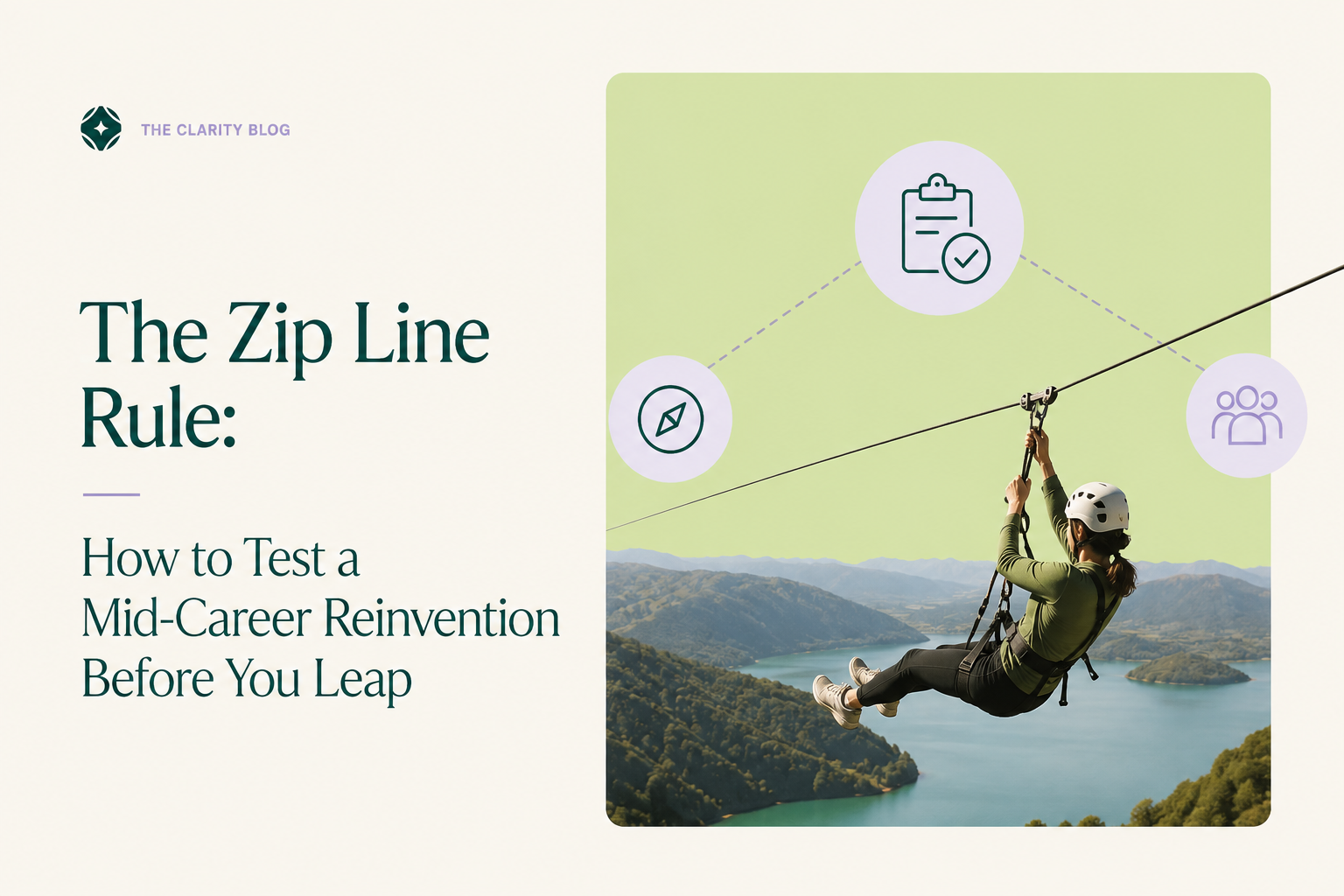
The Zip Line Rule: How to Test a Mid-Career Reinvention Before You Leap
Mid-career reinvention doesn’t have to start with a leap. Test the waters with one small, low-stakes experiment—and let clarity follow action.
Standing at the edge of a platform in New Zealand, one recent Chapter 3 participant spent five straight minutes refusing to jump.
A guide finally gave her a real pep talk. She closed her eyes, let go, and about ten seconds into the ride down the line, she thought: oh, this is it. That was the whole ordeal. Not agony. Just movement, and then it was over.
We opened a recent session by asking the group to think of a time they tried something new purely because they were curious, the same instinct that ends up driving most successful mid-career reinvention. The room came alive. A zip line on the other side of the world. An unplanned locker room speech before the biggest game of a season. Getting back behind the wheel after ten years of not driving at all.
None of those stories involved a five-year plan. Every one of them was a single, contained decision to try the thing and see what happened.
Why this matters for mid-career reinvention
Most career advice assumes you need certainty before you act. Decide, then move. But the professionals who navigate mid-career reinvention most successfully tend to flip that order. They move in small ways first, and certainty follows.
This idea has a name. The book Designing Your Life calls it prototyping: instead of betting everything on one big decision, you build small, low-stakes versions of a possible direction and see how they actually feel before you commit to anything.
What a prototype actually looks like
A prototype is not quitting your job. It's smaller than that, almost embarrassingly small.
One participant curious about coaching didn't launch a business. She offered a single free workshop at her local library to see if she even enjoyed teaching a room full of strangers. Another, exploring a pivot into consulting, didn't build a company. He had a handful of honest conversations with people already doing that work, not to ask permission, but to understand what their actual Tuesday looked like.
That second move has a name too. Designing Your Life calls it a life design interview: a short, structured conversation where the only goal is information, not a job offer and not anyone's blessing.
Why the leap feels bigger than it is
Here's what tends to happen without a prototype. An idea sits in your head for months, growing heavier every time you think about it, until quitting your job starts to feel like the only way to finally test it.
But you don't test a direction by blowing up your life. You test it the way you'd test anything else you weren't sure about: small, cheap, and reversible, with a real conversation or a real experience instead of another few weeks of thinking about it.
What experimentation actually builds
Every person in that opening exercise had already proven, at some point in their life, that they could do a hard, uncertain thing and come out fine on the other side. The zip line. The speech. Getting back in the driver's seat.
That capacity didn't disappear. It's just been sitting unused for a while, waiting for something worth testing.
Where to start this week
Pick one idea you've been circling for months. Then design the smallest possible version of it, one conversation, one afternoon, one free session, something you could realistically do by Friday.
The plan can come later. The step can't wait.
This is exactly the muscle we build inside the Clarity Program, where every direction gets tested in the real world through small, structured experiments before anyone commits to anything bigger.
So, what's the smallest version of your next chapter you could test this week?

AI Can Help Your Mid-Career Reinvention. It Can't Replace the People In the Room.
AI can help you explore your next chapter, but it can’t replace the people who challenge, support, and inspire you along the way. Real reinvention happens when clarity turns into action—with others in your corner.
Somewhere close to midnight, a lot of smart, accomplished people are asking ChatGPT if it's too late to change careers.
They ask it what their skills are actually worth. They ask it to draft a bio that sounds like where they're headed, not just where they've been. For a lot of people quietly working through mid-career reinvention, a chatbot has become the first stop, long before a coach or a peer group ever enters the picture.
And most of the time, it gives them something useful back.
Where AI actually earns its place
AI-powered tools have gotten genuinely good at the parts of career clarity that used to eat up an entire weekend. They can organize scattered ideas into something coherent, draft a first version of a bio, or sort through old performance reviews to find patterns you'd have missed on your own.
If your resume hasn't been touched since 2011, AI can make the blank page a lot less terrifying. It can summarize your last ten years in a paragraph you'd actually be proud to send. That's real, and it's worth using.
What it quietly can't do
Here's what AI has never once done for anyone working through a real career transition.
It has never noticed the exact moment someone stopped hedging and started speaking with conviction, then called them on it the next time they slipped back. It has never sat with someone in a hard week and said, I know this is scary, and I'm not going anywhere. It has never made a direct introduction to someone who's already done the thing you're trying to do.
Take someone who wants to build an AI consulting practice, helping smaller companies figure out where the technology could actually help them. AI can be part of that plan from day one, drafting the pitch and researching the market. But what actually moves a plan like that forward is usually a person, someone pointing to another person doing something similar and saying, follow her, watch how she built it.
That's inspiration and support a tool can't manufacture, because both come from someone genuinely invested in you.
That's not a small distinction. That's the whole thing.
Why this matters more now, not less
The more AI takes over the parts of career clarity that used to require hours of grunt work, the more obvious it becomes what's actually left. What's left is accountability, support, and inspiration, three things no algorithm has ever supplied, no matter how good the prompt.
An algorithm can hand you five possible directions in ten seconds. It cannot look you in the eye and tell you that you've talked about the same idea for eight months and never once picked up the phone. It cannot sit next to you on a hard day and remind you why you started.
And it cannot be the reason you finally believe a leap is possible, because you watched someone just like you make it first. Only a person does all three.
The real risk of going it alone with a chatbot
This isn't a caution against AI. It's a caution against mistaking a tool for a relationship.
Plenty of professionals in their 40s and 50s spend a full year going back and forth with an AI assistant, refining the same three ideas without ever testing one. The tool never gets tired of the conversation. It never pushes back.
It also never worries about you or celebrates with you.
That's the gap. Not intelligence. Accountability, support, and inspiration, the things that come from people who are actually rooting for you, not just responding to you.
A chatbot will happily help you think about a career change after 40 for as long as you want, without ever once asking why thinking is all that's happened so far.
Where clarity actually comes from
Clarity has never come from having more information. It comes from someone who can hold up a mirror, ask the harder question, cheer you on when you're scared, and stay in your corner while you answer it honestly.
This is exactly why Find My Chapter 3 pairs AI-powered tools with real facilitators and a small group of people working through the same thing you are. The tools do the heavy lifting on organizing and drafting. The humans, inside the Clarity Program, do the part no tool can.
They hold you accountable, they support you through the parts that feel scary, and they inspire you simply by showing you it's possible. They believe in you before you believe in yourself, and they hold you to it.
So, if you've been treating a chatbot like your career coach, what's the one conversation you've been avoiding having with an actual person?

What You Loved Doing at 10 Might Be the Clue to Your Next Chapter
The activities that lit you up at age 10 may still hold clues about what energizes you today. Revisit your childhood interests to uncover the thread that could shape your next chapter.
A library with beanbag chairs. An afternoon spent building forts out of nothing. A stack of ten books checked out because one felt like too few.
Ask any group of adults what they loved doing as a child, and something interesting happens. The answers come fast, specific, and full of energy, even from people who swear they don't know what they want anymore.
I ask this question often in the Clarity Program, and it never fails. People who've spent twenty years describing themselves through job titles suddenly light up talking about badminton, needlepoint, or hours spent in a library.
Why childhood interests actually matter
This isn't nostalgia for its own sake. Before career pressure, financial responsibility, or anyone else's expectations shaped your choices, you were drawn to certain things purely because you loved them.
Those signals didn't disappear. They got buried under decades of doing what paid the bills and what looked responsible.
The exercise, step by step
Start by giving yourself thirty seconds to think back to childhood, no editing allowed. What did you do with your free time? What made you lose track of it completely?
Write down three or four things, even if they seem unrelated to any career. Then ask which of them you still do today, and which ones quietly disappeared.
Finally, look for the thread underneath the activity itself. It's rarely the specific hobby that matters. It's what the hobby gave you, connection, creativity, competition, order, performance.
One thread, many directions
I've watched this exercise surface a love of performance that turned into a passion for coaching, and hours spent in a library as a kid that pointed straight toward a desire to teach later in life. The specific activity from childhood rarely becomes the second act exactly as it was.
But the thread underneath it almost always shows up somewhere in a meaningful next chapter.
Try it yourself
Take the thirty seconds right now. Not later, not once things calm down.
What you loved before anyone told you what you should love is still worth listening to.
This is one of the exercises we walk through together in the Clarity Program, alongside your talents, needs, and desires, to help you build a genuinely complete picture of your next chapter.
So, what's the one thing you loved doing as a kid that you haven't thought about in years?
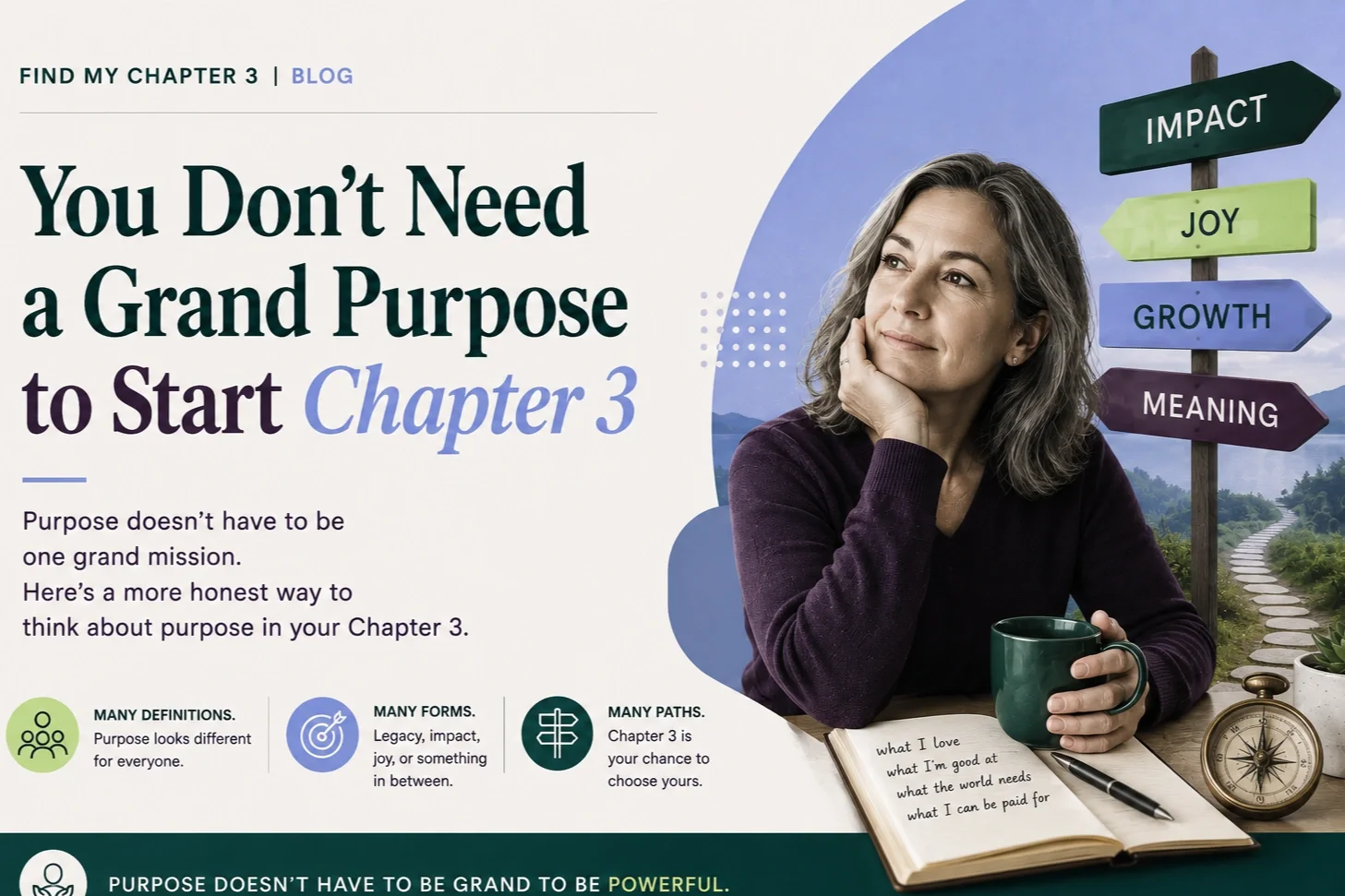
You Don't Need a Grand Purpose to Start Chapter 3
Purpose doesn't have to be your life's biggest achievement. It can simply be the work, people, and moments that matter most to you right now.
Purpose is one of the heaviest words in the English language, right up there with legacy and destiny.
Say it out loud in a room full of accomplished professionals and watch what happens. Some people light up. Others go quiet, convinced they're supposed to have a mission statement for their life and somehow missed the memo.
Neither reaction is wrong. Purpose means something different to almost everyone, and that's actually good news.
Purpose as legacy
For some people, purpose is about what they leave behind. Not fame, just impact that outlasts them: a stronger team, a more capable next generation, kids who inherit a steadier world than the one they were handed.
If this is you, purpose doesn't require a grand new mission. It requires clarity about who you're building for.
Purpose as making a difference every day
For others, purpose is simpler and more immediate. It's knowing that what you did today mattered to someone, and being able to point to it.
This is often the hardest kind of purpose to lose, because the ache isn't about ambition. It's about missing the feeling of moving the needle.
Purpose as joy
Some people are done chasing meaning through achievement entirely. Their honest answer is that purpose, right now, means enjoying life and the people in it.
That's not a smaller answer. It's just a different one, and it deserves the same respect as any five-year plan.
The ikigai approach
There's a Japanese framework called ikigai that asks four questions: what you love, what you're good at, what the world needs, and what you can be paid for. The idea is to find the overlap.
You don't need the perfect overlap on day one. You need enough of it to take a real step, and the willingness to adjust as you learn more.
Purpose doesn't have to live at work
Here's the part worth saying plainly. Purpose doesn't have to come from your job. For some people it will, for others it never has, and pretending otherwise just adds pressure to an already hard transition.
Chapter 3 might be where your purpose and your work finally line up. Or it might be where you stop expecting your job to carry that weight, and build purpose elsewhere on purpose.
Where to start
You don't need to solve this in one sitting, and you definitely don't need a grand unifying answer before you take a next step. You need a clearer sense of what matters to you right now, and a process for testing it.
That's exactly the work we do together in the Clarity Program, helping you define purpose in your own terms instead of someone else's.
So, when you think about your Chapter 3, what does purpose mean to you right now?

Is Your Biggest Obstacle Real, or Is It Just Loud? A Gut Check Before You Pivot After 50
Many professionals over 50 believe they can't afford a career change. But until you've separated facts from fear, you don't know what's truly standing in your way.
Money is the reason most people give for staying stuck. It's rarely the real one.
I hear it every week from professionals ready to pivot after 50: I can't afford to make a change right now. And I believe them, because I told myself the exact same thing for years.
When I was still in the corporate world, my Chapter 3 plan was five years out. Not because I'd done the math. Because I was scared of the math.
The budget I never ran
Eventually I sat down with a financial planner and built a real budget, not a guess, not a fear. What I actually needed to live turned out to be a fraction of what I'd assumed.
My perception was close to five times the reality. I could have made that number work almost any way I chose, even if it meant a very different kind of work for a while.
This isn't a promise that money worries are imaginary
Let's be clear about what this is and isn't. Health insurance between 55 and 65 is a real gap. Supporting a family on one income while a partner's job feels shaky is a real risk. These things deserve respect, not a pep talk.
One professional I coach worried constantly about the years between leaving a steady job and qualifying for Medicare. That worry was legitimate, so we built an actual plan around it instead of letting it block every other decision.
A real obstacle and a perceived one require different responses. A real obstacle needs a plan. A perceived one just needs a closer look.
The question worth asking yourself
Before you decide that a career change after 40 is off the table, ask yourself one honest question. Have I actually run the numbers, or am I reacting to a feeling?
Most people who say they can't afford to change haven't done the exercise. They've done the flinch.
What's actually at stake
Staying in a role that no longer fits you has a cost too, even if it never shows up on a spreadsheet. Years spent numb add up. So does the version of you that never got to try.
Clarity doesn't remove risk. It replaces a vague, oversized fear with a specific, manageable one, and specific fears are a lot easier to plan around.
Where to start
If you're not sure whether your obstacle is real or perceived, that's exactly the kind of question we dig into inside the Clarity Program. We help you separate the noise from the numbers, so your next decision is based on facts instead of flinches.
So, which obstacle have you been carrying around that you haven't actually challenged yet?

Four Stages of Mid-Career Reinvention (and Which One You're In)
Feeling restless in your career but unsure what comes next? Mid-career reinvention isn't a single decision. it's a journey through distinct stages. Whether you're exploring new possibilities, seeking stability, preparing for change, or ready to take action, understanding your current stage helps you focus on the work that matters most and move toward your next chapter with confidence.
Somewhere between climbing the ladder and wondering why the view doesn't feel like enough, most professionals hit a wall. You've built real expertise. You've earned respect.
And still, something in you is asking what comes next. That question can feel enormous, so let's make it smaller.
Through years of guiding professionals in their 40s and 50s through mid-career reinvention, I've noticed that everyone lands in one of four stages. Knowing yours won't hand you an answer. It will tell you what kind of work to do next.
Exploring: you're sensing something
If you're in the exploring stage, you feel restless but you don't need answers yet. Something is nudging you, a meeting that felt hollow, a Sunday night dread that showed up early.
You're not ready to act. You're ready to understand what's driving the restlessness.
The work here is curiosity, not commitment. Notice what drains you and what lights you up, and write it down before you talk yourself out of it.
Stabilizing: you need room to think
Stabilizing means your system is asking for space before it can ask for direction. Maybe work has been chaotic, or life just handed you a curveball.
You can't make a big decision from inside a storm.
If this is you, steadiness comes first. Clarity tends to show up once the noise quiets down, not before.
Preparing: you're motivated but not clear
In the preparing stage, effort was never the problem. You'd move tomorrow if you knew exactly where.
What's missing is clarity, and a low tolerance for unnecessary risk.
This is where most of the real work of Chapter 3 happens. You need a structured way to name your talents, your interests, and the paths that actually fit them, not a leap of faith.
Activating: you're ready to move
If you're activating, the exploring is largely done. You don't need convincing. You need a plan and a first step.
That first step is rarely the whole plan. It's usually smaller than people expect, one conversation, one experiment, one honest budget review.
Why the stage matters more than the timeline
Here's the part people miss. Your stage matters more than how fast you move.
I've coached people whose timeline was six months and people whose timeline was five years, and both were exactly right for them.
What changes everything is doing the work that matches where you actually are. Trying to activate before you've explored just leads to a plan you'll abandon, and trying to explore forever becomes its own kind of stuck.
Where clarity actually comes from
None of these stages are permanent. You could be preparing this month and activating by fall.
The goal isn't to rush yourself into the next one. It's to do the work your current stage is asking for, so the next one arrives on its own.
This is exactly what we walk through in the Clarity Program, a small-group, facilitated experience built for professionals figuring out their next chapter. We help you name your stage honestly, then do the specific work that moves you forward from there, not from where you wish you were.
So, which stage feels most like where you are right now?

What You've Been Known For Doesn't Have to Be What People Know You For
For years, your title may have been the easiest way to explain who you are. But as your priorities evolve, the identity you built does not have to limit what comes next. Discover why reshaping your professional identity is not about starting over but about building on everything you have already achieved while creating space for a more meaningful Chapter 3.
Why the professional identity you built doesn't have to define what comes next.
For most of your career, the answer to "what do you do?" came easily.
A title. A function. An industry. Maybe a company name that carried its own weight.
You did not just hold that title. You became it. Over years and decades, it shaped how colleagues introduced you, how your network thought of you, how you walked into a room. It became shorthand for your value, your expertise, and your place in the professional world.
And you earned it. That matters.
But here is the question that more experienced professionals are sitting with quietly: does that identity still fit? And more importantly, does it have to define what comes next?
When the Title No Longer Tells the Full Story
There is a particular kind of tension that builds when the professional story you have been telling the world no longer matches the one you want to be living.
You are still the person the title describes. You can still do the work. But something has shifted. The role feels too narrow, or too demanding, or simply no longer aligned with who you have become and what you want your days to look like.
The challenge is that titles have gravity. The longer you hold one, the more it becomes attached to your personal brand. Colleagues associate you with it. Your LinkedIn profile reflects it. Your network refers opportunities to you based on it. It is not just a job description. It is a reputation that took years to build.
And walking away from it, even partially, can feel like giving something up rather than gaining something.
According to the World Economic Forum's Future of Jobs Report 2025, employers expect 39 percent of workers' core skills to change or become outdated by 2030. The external world is already demanding that people redefine how they work and what they are known for. But for experienced professionals, the internal permission to do so often arrives much later than the desire.
The Identity Is Not the Problem. The Attachment to It Can Be.
Being known for something specific is not a liability. It is evidence of real contribution over real time.
The question is not whether your past professional identity has value. It clearly does. The question is whether it is the only story you are allowed to tell going forward.
Most people at this stage assume it is. They have been a CFO or a healthcare executive or a senior operations leader for so long that any other description feels inaccurate, or presumptuous, or simply unfamiliar. The identity they have built feels like a fact rather than a choice.
But professional identity is always a choice. The story you tell about yourself, the way you describe your value, the roles and contexts you pursue, these are decisions. They were decisions when you built the identity you have now. And they are decisions again as you think about what comes next.
The Careershifters State of Career Change Report 2026 found that three in four professionals considering a career transition have been thinking about it for more than a year without making meaningful progress. The most common barrier is not a lack of ideas or options. It is the difficulty of letting go of an identity that took decades to build, even when that identity no longer fully fits.
Why Gradual Reshaping Works Better Than Reinvention
The idea of reinvention is seductive but rarely accurate.
Most professionals who successfully reshape their identity in Chapter 3 do not do it through a single dramatic announcement. They do not wake up one morning and declare themselves something completely different. They evolve.
It starts with introducing new aspects alongside the established ones. A conversation where you mention an emerging interest. A project that sits slightly outside your traditional lane. A way of describing yourself that emphasizes where you are going, not just where you have been. Small, consistent moves that begin to build a different picture over time.
The old identity does not disappear. It becomes context rather than definition. The decades of experience you accumulated remain part of your story. But they shift from being the headline to being the foundation that makes the next chapter credible.
This gradual approach works for two reasons.
First, it is less threatening internally. You are not being asked to abandon what you built. You are being asked to expand it, to introduce new elements while the familiar ones remain present. That feels manageable in a way that wholesale reinvention does not.
Second, it is more effective externally. The people in your network who have known you in one role for years do not update their perception of you overnight. But they do update it over time, as they see new aspects emerge consistently. Signaling a shift gradually gives your network the chance to grow with you, rather than being surprised by a change that feels sudden or unexplained.
What the Reshaping Actually Looks Like
In practice, reshaping a professional identity often begins with language.
Before this kind of work, most people describe themselves entirely in terms of the past. Their titles, their responsibilities, the organizations they have worked for. These descriptions are accurate, but they point backward.
After doing the work of genuinely exploring what belongs in Chapter 3, something different starts to emerge. People begin describing themselves in terms of where they are going alongside where they have been. They introduce interests and capabilities that had no room in their previous professional story. They start to talk about the kind of contribution they want to make, not just the kind of work they have done.
That shift in language is not cosmetic. It reflects a real change in how they see themselves and what they believe is possible. And it is what allows the people around them to begin updating their picture too.
Mark came into Find My Chapter 3 with a head full of ideas and no clear sense of which ones were worth pursuing. He left with what he described as a fresh perspective and a better understanding of where he wanted to focus his time and energy going forward. Not a new title. A new direction. And with it, a new way of talking about himself that opened doors the old description had not.
The Question Worth Sitting With
If you have been known for something specific for a long time, here is a question worth taking seriously.
Is that identity something you chose, or something that accumulated?
For most people, the honest answer is a mix of both. You made choices that led to the role. But you also followed the path that was available, responded to what was rewarded, and became what the environment around you reinforced.
Chapter 3 is often the first real opportunity to make the choice more deliberately. To decide, based on who you have become rather than who you were, what you want to be known for next.
That decision does not have to be made all at once. It can be made gradually, one conversation and one new introduction at a time.
Find My Chapter 3 helps experienced professionals do exactly that: build clarity about what belongs in the next chapter, develop the language to describe it, and begin the gradual process of reshaping how they are known, in a way that honors everything they have built while making room for what comes next.
What People Really Mean When They Say They've Lost Their Purpose
When people say they've "lost their purpose," they are often describing something far more practical than a philosophical crisis: a loss of energy, direction, and momentum. This Blog explores why purpose is less about finding a grand calling and more about discovering meaningful ways to use your experience, contribute to others, and regain a sense of forward movement.
And a simpler, more useful way to find it again.
There is a sentence that comes up in conversations about career transitions more than almost any other.
"I just don't feel energized anymore."
Not: I don't know what my purpose is. Not: I am searching for meaning. Just a quiet, persistent flatness. A lack of forward pull. The feeling of going through the motions without knowing why.
For most experienced professionals, that is what the loss of purpose actually feels like. Not a philosophical crisis. An energy problem.
And it turns out the research agrees.
The Energy Problem Nobody Names Correctly
According to the Cigna Group's 2025 Vitality in America report, which surveyed 5,000 U.S. adults, people with a strong sense of purpose are five times more likely to say they feel energized than those without one. They are also nearly three times as likely to look forward to each new day.
Read that again. Five times more likely to feel energized.
That is not a small difference. That is the difference between a day that pulls you forward and one you simply get through.
And yet when most people talk about purpose, they reach for language that feels too big, too abstract, too philosophical. What is the meaning of my life? What is my true calling? What was I put on this earth to do?
Those are real questions. But they are not always the most useful ones. And for experienced professionals navigating a career transition, they can become a source of paralysis rather than clarity.
Why "Purpose" Can Feel Like the Wrong Question
Arthur Brooks, Harvard professor and author of the recent number one New York Times bestseller The Meaning of Your Life, argues that meaning centers on three questions: why do things happen the way they do, why are you doing what you're doing, and why does your life matter and to whom.
Those are profound questions. Worth sitting with. Worth exploring over a lifetime.
But here is the honest truth for most people in the middle of a career transition. They are not looking for transcendence. They are looking for a reason to get out of bed on a Tuesday.
One participant, Payton, came into the program with a simple but powerful statement: he wanted to find happiness in Chapter 3. That prompted a deeper exploration of what happiness actually means, and Arthur Brooks' three-part framework, enjoyment, satisfaction, and meaning, became a lens the entire cohort used to understand not just what they were missing, but why.
A Simpler Definition That Actually Works
Viktor Frankl, the psychiatrist and Holocaust survivor whose book Man's Search for Meaning remains one of the most widely read works on the subject, identified three paths to meaning: what you give to the world through work or contribution, what you receive from love and beauty and connection, and the attitude you choose toward suffering you cannot change.
Frankl's work is extraordinary. But for most people sitting in a career transition, his framework, as valuable as it is, can still feel like it belongs to a different conversation.
Here is a simpler starting point.
Purpose does not have to be a grand declaration. For most people, it comes down to something much more straightforward: doing something that helps others, in a way that draws on the experience, skills, and perspective you have accumulated over a lifetime.
That is not a diminished version of purpose. That is purpose as it is actually lived by most people who have found it.
The question that unlocks it is not: what is the meaning of my life?
It is: how will I spend my time in a way that matters?
That shift, from the cosmic to the practical, is often all it takes to move from paralysis to forward motion.
What the Absence of Purpose Actually Does to People
It shows up first as energy. Or rather, the lack of it.
People stop feeling excited by what they do. The things that used to generate energy start to drain it instead. Days feel full but flat. There is plenty on the calendar, but nothing that pulls them forward with any real force.
The Cigna research adds important context. Less than one in three Americans currently report having a strong sense of purpose. Among those who do not, the contrast in daily experience is stark. Not just less energized, but significantly less likely to look forward to the day ahead, less likely to engage in healthy habits, less resilient at work.
The absence of purpose is not a philosophical problem. It is a daily lived experience that affects how people feel, how they function, and how they show up in every part of their lives.
What Finding a Direction Actually Changes
The shift does not require a complete answer. It requires enough of one to start moving.
Here is what that looks like in practice.
Mark joined Find My Chapter 3 with a head full of ideas and no clear sense of which ones were worth pursuing. By the end of the program, he had what he described as a practical framework for moving forward with intention, and a fresh perspective on where to focus his time and energy. Not a finished answer. A direction.
Chamblin had left her corporate career knowing she had a greater calling but still struggling with changing identities and no clear sense of how to get started. She finished the program having moved, in her own words, from wondering what might be next to trusting herself enough to actually pursue it.
Heather came in spinning through loose ideas with no confidence that any of them were viable. She left every session energized, not just about her own path, but about her fellow cohort members' journeys.
None of these are stories of sudden revelation. They are stories of clarity arriving gradually, through structure and reflection and the presence of other people asking the same questions. And in each case, the first thing that returned was not certainty. It was energy.
Where to Start
If the question "what is my purpose" feels too big to answer, try a different one.
What would I do with my time if I knew it was genuinely useful to someone else?
That question tends to produce answers much faster. And the answers it produces tend to be grounded in real things: skills you actually have, people you genuinely want to help, problems you are drawn to work on.
Purpose at this stage of life is rarely discovered through introspection alone. It is built through doing. Through small experiments that generate real signals. Through conversations that reveal what lights you up and what leaves you flat. Through the gradual, sometimes uncomfortable process of translating a life's worth of experience into something that feels meaningful again.
The energy comes back when the direction starts to take shape. Not before.
Find My Chapter 3 is a structured, small-group program that helps experienced professionals do exactly that: move from the unanswerable version of the question to the actionable one, with the structure, support, and accountability to keep moving when reflection alone runs out.

The Last Rodeo: Why Some of the Smartest Career Moves Look Like Steps Backward
The smartest career transitions rarely look like dramatic leaps. Discover why experienced professionals often make one strategic move backward to build the future they truly want.
What experienced professionals know about intentional transitions that most career advice completely misses.
There is a moment that does not get talked about enough in career conversations.
It is not the dramatic leap. It is not the bold pivot. It is not the announcement that you are finally doing what you always wanted to do.
It is something quieter and more strategic than any of those. It is the deliberate decision to make one more move in your current lane, not because it is exactly what you want, but because it creates the conditions for what comes next.
In the world of rodeo, they call it the last ride. In career transitions, we call it the last rodeo. And for many experienced professionals, it is one of the most important moves they will ever make.
What the Last Rodeo Actually Is?
The last rodeo is not giving up. It is not settling. It is not a failure of ambition.
It is a bridge. A deliberate, intentional transition between where you are now and where you actually want to go.
For most of the professionals who find themselves here, it looks something like this. They know something needs to change. They have a sense of what Chapter 3 might look like. But the circumstances are not yet aligned for the full leap. Financial stability, healthcare coverage, a spouse navigating their own transition, a retirement timeline that needs a few more years of runway.
So they make a calculated move. One more role. One more chapter in the current lane. But this time, chosen with different criteria than every role before it.
Not: what is the biggest opportunity? Not: what will advance my career the furthest? But: what will give me the stability I need and the flexibility to start building what comes next?
That is a fundamentally different decision-making frame. And it changes everything.
Why This Stage Is More Common Than Anyone Admits?
The data on this is striking.
According to a 2024 survey by consulting firm WTW, 15 percent of U.S. workers over the age of 50 are already phasing into a transition, and another 19 percent say they would like to. That is more than a third of the over-50 workforce actively thinking about how to engineer a deliberate off-ramp, not an abrupt stop.
Research from the Transamerica Center for Retirement Studies found that about 58 percent of workers end up retiring earlier than they planned, often due to health issues, organizational changes, or circumstances beyond their control. That number is a quiet reminder that the window for an intentional transition is not always as wide as we assume. The people who plan their bridge tend to fare better than the people who find themselves on one unexpectedly.
And yet despite how common this stage is, it rarely gets named for what it is. People talk around it. They frame their moves in terms of opportunity or growth or strategic alignment. Rarely does someone say out loud: I am taking this role because it is my last rodeo, and I am choosing it specifically so I can get to what I actually want.
That silence has a cost.
The Hidden Stigma of the Intentional Downshift
Here is something that comes up repeatedly in conversations with experienced professionals navigating this stage.
The move often looks like a step backward on paper.
Less responsibility. Lower pressure. Maybe a smaller title. Maybe a move from a high-profile role to something steadier and more sustainable.
From the outside, it can look like retreat. Like someone who peaked and is now coasting. And in a professional culture that still equates ambition with forward momentum at all times, stepping deliberately sideways or down carries a stigma that most people are not prepared for.
This is why the conversation about intentional downshifting tends to happen in anonymous spaces rather than open ones. People will talk about it on Reddit under a username that no one in their professional network can connect to them. They will whisper about it with a trusted colleague over coffee. But they will rarely post about it on LinkedIn or discuss it in a performance review.
The fear is understandable. You have spent decades building a reputation. You do not want a strategic choice to be misread as a decline.
But here is what is actually true. The intentional downshift is not a retreat. It is a reallocation. You are not giving up momentum. You are redirecting it toward something that matters more.
The problem is not the move. The problem is the absence of a clear narrative around it.
Clarity Is What Turns Retreat into Strategy
When someone can articulate clearly why they are making a move, the move changes shape entirely.
Not just to themselves, but to anyone they tell.
"I am stepping into a role with less travel and less organizational complexity because I am using this period to build something on the side that I want to move into full time within three years."
That is not a step backward. That is a plan. And when you say it that way, most people do not hear retreat. They hear intention. They hear someone who knows exactly what they are doing and why.
The professionals who navigate the last rodeo most effectively are the ones who enter it with that kind of clarity. They know what the bridge is for. They know what they are protecting and what they are building toward. And they have made specific choices about the role they are taking, precisely because it leaves room for the next chapter to develop alongside it.
The ones who struggle are the ones who fall into a last rodeo without that clarity. They take what is available. They tell themselves they will figure out what comes next once they land. And then the bridge quietly becomes the destination, not because they chose it, but because no one helped them build the map before they crossed it.
What Choosing Your Last Rodeo Intentionally Actually Looks Like?
Payton had spent more than two decades in the hospitality industry. He knew something needed to change. He could feel the pull toward a different kind of contribution. But he was not ready for a cold leap into the unknown.
What he needed was a role that would give him more flexibility, more breathing room, and more time to make progress on what he was actually building toward. Not a lesser role out of defeat. A different role out of design.
After working through the Find My Chapter 3 program and completing his clarity map, he had something he had not had before: a written picture of where he was, where he was going, and what mattered most in the move he made next. That clarity changed how he evaluated opportunities. Instead of asking what is the biggest next step, he started asking what creates the most room.
He found a path that looked like a lateral move on paper. What it actually was, was a launching pad.
In his own words: "I was able to step back, evaluate, and leap forward to pursue a new career path that I most likely would not have chosen if I had not taken the course."
The Question That Changes the Decision
If you are navigating this stage, or approaching it, there is one question worth sitting with carefully.
Are you choosing your last rodeo? Or are you falling into one?
The difference matters more than most people realize. Because the last rodeo is not a concession to circumstances. Used intentionally, it is one of the most powerful moves available to an experienced professional.
It buys time. It protects stability. It creates space. And when you enter it with a clear map of what comes after, it becomes not an ending of something, but the beginning of a very deliberate next chapter.
Find My Chapter 3 helps experienced professionals build that map before they make the move, so that the bridge they cross is one they chose, not one they stumbled onto.
Because the last rodeo should be yours to ride on your own terms.

Is Your Past an Anchor or a Foundation?
When you've spent decades building a career, it's natural to wonder whether everything you've created is helping you move forward or quietly holding you in place. The answer isn't about abandoning your past. It's about understanding whether you're carrying it like an anchor or standing on it like a foundation and why that distinction can shape everything about your next chapter.
The question most experienced professionals quietly ask themselves, and why the answer matters more than you think.
When your career has been built over decades, the weight of it becomes real. The education. The sacrifice. The identity that grew up around what you did every day.
So when something starts to shift, and it does shift for most people at some point, a quiet question tends to surface.
Is everything I built helping me move forward? Or is it holding me in place?
That question, whether your past is an anchor or a foundation, is one of the most important you can ask at this stage. And how you answer it will shape everything about what comes next.
Why This Question Surfaces When It Does?
This is not a random moment of doubt. There is real data behind it.
According to McKinsey research, 70 percent of employees say their sense of purpose is largely defined by their work. That is a significant number. It means that for most experienced professionals, the career and the self have been deeply intertwined for a long time.
But here is where it gets complicated. The same McKinsey study found that only 18 percent of respondents believed they were getting as much purpose from work as they wanted. That gap, between how much we rely on work for meaning and how much meaning we are actually finding there, is exactly where this question lives.
A 2026 report by Careershifters, based on a survey of over 11,500 professionals, found that three in four career changers had been thinking about making a change for a year or more, and one in four had been considering it for three years or longer. That is a long time to carry a question without resolution. And it points directly to how powerful the resistance to change can be, even when the desire to move is genuine.
The consideration is common. The action is rare. And the gap between those two tells you something important about what is actually getting in the way.
It is rarely a lack of ideas. It is usually a quiet but powerful fear that moving forward means leaving something important behind.
What Does It Mean for the Past to Become an Anchor?
An anchor is not a bad thing by design. Anchors provide stability. But when you are trying to move, an anchor becomes the thing that holds you in place.
For experienced professionals, the past can function as an anchor in a few specific ways.
The first is identity lock. When your career and your sense of self have been tightly connected for a long time, imagining a different kind of work can feel like imagining a different person. The question stops being "what do I want to do next" and becomes "who would I even be if I did something different?"
The second is the sunk cost pull. Decades of investment, in education, in skills, in a specific kind of expertise, create a gravitational pull toward staying in familiar territory. Leaving it behind can feel like writing off everything that came before.
The third is external identity. The title. The credentials. The way other people recognize you. When those markers have been part of how you move through the world, setting them aside even temporarily can feel like losing something real.
None of this is irrational. These are reasonable responses to a real situation. But they are worth examining, because the same past that can function as an anchor is also the raw material for something entirely different.
What Does It Mean for the Past to Be a Foundation?
A foundation is what you build on. It does not disappear when the structure above it changes. It makes the new structure possible.
When your past functions as a foundation, the decades of experience you have accumulated become an asset rather than a constraint. The skills you developed do not belong only to the industry or role where you developed them. They are transferable. The judgment you have built does not expire when your title changes. It travels with you.
The data supports this more strongly than most people expect. According to OECD research on career mobility, older workers who voluntarily change careers typically experience improvements in both wages and the quality of their working environment. The research also found that 60-year-olds who made a mid-career job change were more likely to remain employed than peers who stayed put, suggesting that deliberate career transitions at this stage can actually extend and strengthen working life rather than threaten it.
These are not the numbers of people abandoning their past. They are the numbers of people who figured out how to build on it.
Consider what a long career actually produces, beyond the resume line items. It produces the ability to read a room, a situation, or a problem with a depth of context that takes years to develop. It produces credibility that opens doors a younger professional cannot yet access. It produces a network built on real relationships, not just connections. It produces perspective, the kind that comes from having seen things go wrong and right enough times to know the difference.
None of that disappears. None of that has to be left behind. The question is simply how it gets applied in what comes next.
Why the Distinction Matters So Much at This Stage
Most of the professionals navigating this question have not done anything wrong. They built real careers. They made real contributions. They earned what they have.
The tension they feel is not a sign of failure. It is a sign that the chapter they are in has run its long course, and the next one is starting to pull at them.
A 2025 study published in the Socio-Economic Review, based on data from over 100,000 workers, found that for managers and professional workers specifically, job satisfaction follows a U-shaped trajectory, typically hitting its lowest point during the 40s before rebounding. The dip is not permanent. But navigating it without a clear framework tends to make it feel that way.
What makes this stage different from earlier career transitions is the amount that is at stake, not just financially, but in terms of identity. Earlier in a career, change feels more available. There is less to protect, less to potentially lose. At this stage, the accumulated weight of what has been built can make any movement feel more consequential than it actually is.
That is where the anchor vs. foundation distinction becomes genuinely useful.
If you approach the next chapter from an anchor position, the goal becomes protecting what you have built. Change feels like risk. New directions feel like they require you to walk away from something.
If you approach it from a foundation position, the goal becomes building on what you have. Change feels like extension. New directions feel like they are made possible by everything that came before them.
Same past. Fundamentally different relationship to it.
The Reframe That Changes Everything
Here is what tends to shift things for experienced professionals who work through this question seriously.
Your past is not asking to be abandoned. It is asking to be reinterpreted.
The skills that made you effective in one context do not belong to that context. They belong to you. The leadership experience, the ability to build teams, the strategic thinking, the domain expertise, the hard-won judgment about what works and what does not, these are yours. They came from your history, but they are not trapped there.
What the next chapter actually requires is not a clean break. It requires a translation. Taking what you have built and understanding what it means in a new context, what it makes possible, and how it can be applied in ways that feel energizing again.
This is not about reinvention. It is about evolution. And it starts with deciding, clearly and deliberately, that your past is a foundation you are standing on, not a weight you are carrying.
A Practical Question to Start With
If you are sitting with this tension, here is a useful place to begin.
Rather than asking what you want to leave behind, ask what you would still be doing if none of the external constraints existed. Not the title, not the organization, not the expectation others have built around you. Just the actual work, the parts that genuinely engaged you, the moments where you felt like you were using your best thinking or your real capability.
Those signals do not disappear because a role changes. They are the thread that connects your past to what is possible next.
The goal of Find My Chapter 3 is to help experienced professionals follow that thread, with structure, with support, and with a process that turns reflection into real direction.
Because the honest truth is this: the people who move forward most effectively at this stage are not the ones who leave their past behind. They are the ones who figure out how to build on it.

The New Story Has to Start Before You're Ready
Career transitions rarely begin with certainty. They begin when experienced professionals start signaling where their energy, identity, and ambitions are quietly moving before the path is fully defined.
Why signaling where you're going matters more than having everything figured out.
There's a belief that runs deep in people who have built long, successful careers.
You earn the right to say something by having already done it. You claim the title after you've held the role. You describe the path once you're standing on solid ground.
It's a reasonable instinct. It served you well for decades.
But at this stage of your career, it may be the very thing slowing you down.
The Transition Doesn't Wait for the Narrative
Most experienced professionals approaching a career transition think of their story as something that comes after. First you figure out the direction. Then you test it. Then you commit. Then, only then, do you start talking about it differently.
The problem is that transitions don't work that way.
The narrative doesn't follow the move. It has to lead it.
This isn't about pretending to be something you're not. It isn't "fake it until you make it," which has always been the wrong frame. Faking implies performance. What we're talking about is something more honest than that. It's signaling.
Signaling is simply letting people know where your energy and attention are moving, before you've fully arrived there.
And the reason it matters isn't about image. It's practical. The people around you, your network, your colleagues, your community, can only help you get somewhere if they know you're trying to go there.
Why "Waiting Until It's Clear" Backfires?
Here's what typically happens when experienced professionals decide to wait for certainty before they change their narrative.
They keep showing up the same way. They introduce themselves the same way. They show interest in the same kinds of conversations they've always had. And the people around them, quite reasonably, continue to see them the same way.
Weeks pass. Then months. The internal shift is real, the questions are there, the energy is moving, but nothing on the outside reflects it. And so the people who could open a door, make an introduction, or point toward an opportunity have no idea one is needed.
The silence isn't neutral. It reinforces the old story.
The Identity Gap
There's something deeper underneath this hesitation, and it's worth naming directly.
For most people at this stage, professional identity and self-identity have become the same thing. The title, the function, the industry. These aren't just descriptions of what you do. They're descriptions of who you are.
So when you consider describing yourself differently, especially before you've fully made the move, it can feel like a kind of dishonesty. Like you're claiming something you haven't earned yet.
But consider this: your identity is already shifting. The internal version of you is already asking different questions, paying attention to different things, finding energy in different directions. The old story isn't false. It's just no longer complete.
Beginning to speak about the emerging version of yourself isn't a claim. It's a reflection of something that is genuinely already happening.
What Exploring Language Actually Looks Like?
One of the most useful shifts at this stage is moving from declarative language to exploratory language. You don't have to announce a new identity. You can describe the direction you're moving.
Here's the difference.
Declarative: "I'm a leadership coach now."
Exploratory: "I've spent 25 years in operations, building teams and navigating complex decisions under pressure. Increasingly I'm drawn to the advisory and mentoring side, working with leaders on the kind of decisions that actually shape organizations."
The second version is honest. It names real, specific experience that gives the new direction credibility. It honors the past. It signals the future. And it gives the person listening something useful, a way to connect you to conversations, people, and opportunities that fit where you're actually headed.
You're not asking them to see you as something you haven't become yet. You're inviting them into the journey.
The Bridge Is the Credibility. And the Passion Is the Magnet.
Here's something that gets missed in most conversations about career transitions and personal branding.
The bridge between your past and your future isn't a weakness in your story. It's the most credible part of it.
When someone hears that a 25-year corporate leader is moving toward advisory work, or working with younger professionals, or building something mission-driven, the natural question is: what connects those two things?
But here's what actually happens in that moment, nine times out of ten.
People lean in.
They get curious. They want to know more. A shift toward something you're genuinely passionate about is far more interesting to most people than another lateral move on the same track. It signals self-awareness. It signals courage. And it often makes people reflect on their own unlived directions.
When you articulate the through-line, when you connect your decades of experience to where your energy is now moving, you don't sound like someone starting over. You sound like someone who has earned a very specific perspective and is now choosing to apply it in a way that actually means something to them.
That combination, credibility from the past and genuine passion for what's next, is what makes the new direction both believable and compelling. Without the bridge, even a strong future direction can land as surprising. With it, people nod, get curious, and start thinking about who they know.
Showing Up Differently Is a Practice, Not an Event
Repositioning doesn't happen through one conversation or one announcement.
It happens through small, consistent signals over time.
The types of content you engage with. The events you show up to. The questions you start asking in conversations. The way you introduce yourself when you meet someone new. The things you write about or comment on publicly.
None of these feel dramatic in the moment. But together, they begin to shape how the people around you understand where you're headed. And that understanding is what eventually opens the doors you're looking for.
One participant in a recent cohort described it this way. She had spent 25 years in a corporate career and was beginning to move toward work with younger professionals. When she first tried to talk about it, she defaulted to either her past or her future, but couldn't connect them. The story felt incomplete, almost apologetic.
Once she built the bridge, once she could articulate how her decades of experience leading and developing teams had given her a specific kind of insight that was now pulling her toward developing the next generation, something shifted. Not just in how others received the story, but in how she felt telling it.
The light went on, as she described it.
That's not performance. That's alignment.
The Real Risk
There's a fear underneath the hesitation to signal before you're ready. It's the fear of looking like you're stepping back. Of losing relevance in the eyes of peers who are still climbing the same ladder you just decided to leave.
That fear is real and it deserves to be taken seriously.
But here's what often happens instead. When you share that you're moving toward something you genuinely care about, people don't see a step back. They see someone doing something brave. They see someone choosing meaning over momentum. And more often than not, they want to help.
The professionals who wait, who keep the internal shift private while presenting the same external story, don't avoid that discomfort. They just delay it, while also losing the months or years when their network could have been working with them instead of for a version of them that no longer fits.
The risk of signaling too early is small. You might have a conversation that doesn't land perfectly. You might refine the language a few times before it clicks.
The risk of waiting too long is larger. The people who could help you get somewhere can only do that if they know you're trying to go there.
Where to Start?
You don't need a finished story to begin. You need an honest one.
Start with what's true right now. What are you paying attention to differently? What conversations are energizing you? What are you being drawn toward, even if you haven't fully committed to it yet?
Build the bridge. What in your past connects to where that energy is moving? What have you built, led, or learned that makes the next direction make sense? Name those things specifically. They are the credibility that makes the new direction land.
Practice saying it out loud. Not in a polished, rehearsed way. In a real, conversational way. The kind of thing you'd say to someone you trust at a dinner or a professional gathering.
Notice what happens. Who leans in. Who asks a follow-up question. Who says "you should talk to so-and-so." Those quiet signals are early evidence that the story is working, and that the people around you are beginning to understand where you're going.
You Don't Have to Have Arrived
The narrative doesn't require a destination. It requires a direction.
And the direction is already there, in the questions you're asking, the things pulling at your attention, the work that's starting to feel meaningful in a way the current path no longer does.
Start talking about it. Not because you've figured it all out. But because the people who can help you are waiting to hear which way you're headed.
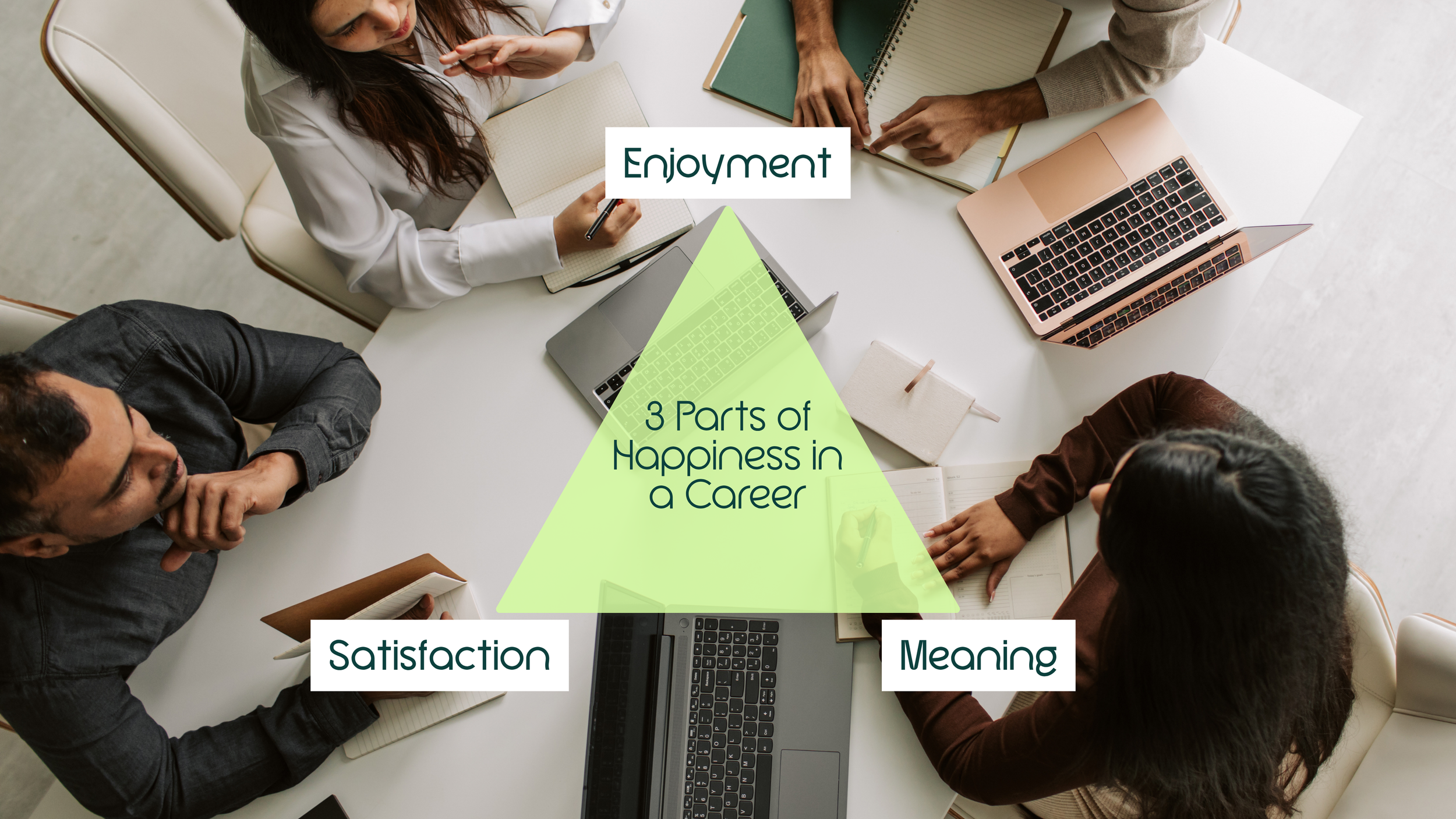
The Three Parts of Happiness Most Careers Eventually Get Wrong
Most careers are built around a script that quietly gives work its meaning. But when that script runs out, many successful professionals discover the problem was never achievement. It was the absence of a new reason to keep going.
Why experienced professionals feel unfulfilled at work, and what to do about it
If you have built a successful career and still find yourself asking "is this it?", you are not alone, and you are not ungrateful. You may simply be missing one of the three components that research shows are essential to genuine happiness at work.
Arthur Brooks, a Harvard Business School professor and one of the leading researchers on the science of happiness, identifies three core elements he calls the macronutrients of happiness: enjoyment, satisfaction, and meaning. Most successful careers deliver two of them reasonably well. The third, meaning, is where things quietly come apart.
What Are the Three Components of Happiness at Work?
Before exploring why meaning erodes, it helps to understand what each component actually means.
Enjoyment is more than pleasure. It is the combination of pleasure, people, and memory working together. It is engagement, connection, the sense that what you are doing is genuinely worth showing up for.
Satisfaction is the reward that comes from striving. It is the joy you get after you struggle for something. Senior professionals often have this in abundance, built across decades of hard work and demonstrated results.
Meaning is different. It is the "why" of your life, and of the three macronutrients, it can be the hardest to develop. It is not about what you are doing on any given day. It is about whether what you are doing connects to something larger than the task in front of you.
Why Mid-Career Professionals Lose Meaning at Work?
Most people do not lose meaning all at once. It erodes gradually, while they are busy building everything else.
To understand why, it helps to think about the script most of us followed.
Go to school. Build your credentials. Get a job. Find a partner. Build a family, in whatever form fits who you are and who you love. Buy a home. Raise children if that is part of your story. Save for retirement. Provide stability. Keep moving forward.
That script gave work a clear purpose.
When you are in your thirties and building all of that, the reason you work hard is obvious. You are supporting the people you love, raising a family, funding a future. The job is not just a job. It is the engine behind everything that matters.
That is a form of meaning. A real and legitimate one.
And for a long stretch, it works. The mission is clear. The stakes are concrete. Every promotion, every raise, every year of stability connects directly to something that feels genuinely important.
But here is what nobody tells you about that script.
It has an ending.
When the Script Runs Out
At some point, the milestones you spent decades working toward start to complete themselves.
The kids grow up and leave. The mortgage gets manageable. Financial security stops feeling like a goal and starts feeling like a baseline. The things that once made the job feel urgent and necessary start to fade as motivators.
This does not happen overnight. It is a slow shift, layered across years of ordinary life. You are too busy to notice it while it is happening. Work is demanding. Life outside of work is full. There are always things pulling your attention forward.
But eventually, something creates a pause.
Maybe it is a change at work, a new boss, a reorganization, a role that no longer fits who you have become. Maybe it is a milestone birthday. Maybe it is watching your children move into their own lives and realizing the house feels different now. Maybe it is reaching a financial point where you finally have options, and the freedom feels disorienting rather than liberating.
Whatever the trigger, the question that surfaces is usually the same.
"What do I actually want to do next?"
And underneath that question is a quieter one.
"What is the point of all this now?"
Why Meaning Is the Hardest Component to Rebuild?
Earlier in a career, meaning is often borrowed from the script. You work hard because the people you love depend on it. The why is external and concrete.
But when the script completes, that borrowed meaning starts to thin.
And if you have not built a new source of it, you are left with enjoyment and satisfaction but a growing sense that something essential is missing.
This is not a crisis. There is no single moment where things fall apart. What most people describe is a gradual erosion. Work that once felt engaging starts to feel routine. Goals that once felt important start to feel hollow. The achievements keep coming, the recognition keeps arriving, but the emotional weight of it all gets lighter.
You are still performing. You are still showing up. From the outside, everything looks exactly as it should at this stage.
But internally, the alignment is off.
And because life stays busy, because there is always something demanding your attention, most people do not stop to examine the drift until something forces them to. When they finally do pause, one of the most common realizations is that this has been building for longer than they thought. Not months. Years.
How to Assess Your Happiness at Work?
If this resonates, the most useful thing you can do is resist the urge to jump straight to solutions.
Before exploring new directions or making decisions, it helps to get an honest picture of where you actually stand. Start with the three components Brooks describes and assess each one honestly.
Where does your work currently land on enjoyment? Not whether the job is fine or tolerable, but whether it genuinely engages you. Whether you feel present and connected to what you are doing day to day.
Where does it land on satisfaction? Do you still feel the reward that comes from striving? Or has the work become comfortable enough that the sense of real accomplishment has faded?
And where does it land on meaning? Does what you do every day connect to something that feels genuinely important to you at this stage of your life, not the stage you were in fifteen years ago?
Most people can identify the gap fairly quickly when they sit with these questions honestly. For the majority of experienced professionals, meaning is where the deficit shows up most clearly.
That assessment is not a small thing. Naming the gap is the first step toward doing something about it.
Happiness Is a Direction, Not a Destination
Brooks and Oprah Winfrey, his co-author on the bestselling "Build the Life You Want," describe happiness not as a destination but as a direction. The goal is not to arrive somewhere perfect. It is to move toward better alignment, consistently, over time.
Which means the drift is not a verdict. It is information.
It is telling you that the source of meaning that carried you through the first half of your career has run its course, and it is time to build a new one.
For most people at this stage, that new source of meaning is not found by starting over. It is found by looking honestly at who they have become, what they have built, what they care about now, and asking a different question.
Not "what should I do?"
But "what kind of work would feel genuinely meaningful at this point in my life?"
That is a harder question. It requires more than reflection. It requires a way to explore, test, and build confidence through real experience rather than thinking alone.
But it is the right question. And for a lot of people, it is one they have been circling for years without quite naming it.
What to Do When Meaning Is Missing from Your Work?
The professionals I work with are not unhappy in any dramatic sense. They are successful, capable, and respected. Many of them would say their lives are good.
But when you ask them whether their work feels meaningful in the way it once did, the answer is usually some version of no.
Not because they failed. Because the script ran out and nobody handed them a new one.
The work of building what comes next is not reinvention. It is not starting over. It is not blowing up what you have built.
It is the work of finding a new source of meaning that fits who you are now, not who you were when the script was written. And it starts with an honest assessment of where your enjoyment, satisfaction, and meaning actually stand today.
If you are at that point and want a structured way to move through it, that is exactly what Find My Chapter 3 is built for.

I'm Good at It. I'm Just Not Excited About It Anymore.
When nothing is broken in your career, the case for change is hardest to make. If you are carrying the quiet realization that you are good at your job but no longer excited by it, you are not alone. Learn how to transition from internal reflection to external structure to create real momentum.
There's a specific kind of stuck that doesn't look like stuck from the outside.
Your career is solid. Your reputation is intact. You're competent, experienced, and by most measures, doing well. The people around you would be surprised to hear that anything feels off.
But internally, something has shifted.
The work that once challenged you now feels familiar. The goals that once mattered don't carry the same weight. And somewhere in the space between meetings, or on a commute, or late at night when things finally slow down, a quiet thought surfaces:
I'm good at this. I'm just not excited about it anymore.
If that sentence landed somewhere specific when you read it, you're not alone. And you're probably not as close to figuring out what to do about it as you'd like to be.
Why This Particular Kind of Stuck Is So Hard to Move
Most career transitions are driven by something going wrong. A bad situation. A difficult manager. A company that's headed somewhere you don't want to go.
This isn't that.
This is something subtler, and in many ways harder to act on. Because nothing is actually broken. The paycheck is there. The title is respectable. The skills are real. From every external measure, there's no obvious reason to change anything.
And that's precisely what makes it so difficult to prioritize.
When something is clearly wrong, the case for change makes itself. When something is simply no longer right, the case for change requires you to make it. Against the demands of a full schedule. Against the comfort of expertise. Against the very reasonable fear of trading something that works for something uncertain.
So most people don't act. Not right away.
They think about it. They research a little. They have conversations with people they trust. And then the week fills back up, work takes over, and the exploration quietly gets pushed down the list again.
This can go on for a surprisingly long time.
The Weight of Carrying This for Years
Here's something worth saying directly: most people who eventually do something about this have been sitting with it for two or three years before they take any real action.
That's not a character flaw. It's a completely understandable response to a genuinely difficult situation.
When you're still performing well, leaving feels premature. When you're financially stable, risk feels unnecessary. When you've spent decades building expertise in something, walking away from it feels like a loss, not just a change.
So you wait. You tolerate. You tell yourself you'll figure it out when things slow down a little.
But things rarely slow down. And the question doesn't go away.
It just gets heavier.
What's Actually Holding You in Place
It's worth being honest about what's really going on when someone stays stuck at this stage.
It's not that they lack ideas. Most people at this point have several. Consulting. Advising. Joining something more mission-driven. Building something of their own. The possibilities are usually there.
What's missing is confidence in which direction is worth pursuing, and a structured way to actually test it without making a costly or visible mistake.
But underneath even that, there's something else.
Comfort and expertise are real anchors.
You're not just uncertain about what's next. You're also being asked to step away from something you're genuinely good at. Something you've spent years building. Something that, even if it no longer energizes you, still represents a real and significant part of who you are.
That's not a small thing to walk away from. And pretending otherwise doesn't help.
The honest reality is that at this stage, the hesitation isn't irrational. The risk is real. The identity question is real. The financial consideration is real.
What's also real is that staying put has its own cost. Not a visible one. But a slow, accumulating one.
What Actually Creates Movement
Here's what's interesting about the people who do eventually make progress on this.
It's rarely a single bold decision. It's rarely a dramatic leap. And it almost never comes from more time spent thinking alone.
What tends to shift things is much simpler, and in hindsight, more obvious.
They write it down. They say it out loud to other people. They build a plan.
Something about moving the thinking out of your own head and into the world changes the nature of it. Ideas that seemed fragile become more tangible. Directions that felt vague start to take shape. And the question that's been sitting in the background for years starts to feel like something that can actually be worked on.
That shift, from internal reflection to external structure, is where progress begins.
Not because the answers suddenly appear. But because for the first time, the problem has a container. And a container makes movement possible.
The Question Worth Asking Yourself
If you've been carrying some version of "I'm good at it, I'm just not excited about it anymore" for longer than feels comfortable to admit, it's worth pausing on one thing.
Not what you should do next. That question tends to spin without traction when asked too early.
But this one: what would it look like to actually work on this, in a structured way, over the next 90 days?
Not to have it figured out. Not to make a decision. Just to move it forward, deliberately, with the right process and the right people in the room.
Because at this stage, the goal isn't a perfect answer.
It's momentum. And momentum starts with deciding that this question deserves more than the spare mental energy left over at the end of a demanding week.
You've been good at a lot of things for a long time.
Figuring out what comes next deserves the same level of seriousness.

The Career Move Earth Day is Asking you to Make
True alignment is not a luxury, it is a practice. As the job market shifts under the influence of AI, experienced professionals are choosing to point decades of rare expertise toward purpose driven organizations. Here is why this spring is the ideal time to design your own intentional transition.
Something shifts in April.
The days get longer. The air changes. And for a lot of professionals in their 40s and 50s, a question that has been sitting quietly in the back of their minds starts getting louder.
Is this really what I want to be doing?
This year, that question has more urgency behind it than ever.
In March alone, AI was cited as the leading cause of job cuts for the first time in history, accounting for 25% of all layoffs, up from just 8% the month before. White-collar roles in analytics, administration, and mid-level management are feeling it most. The professionals I talk to are not panicking. But they are paying attention.
And this Earth Day, I keep thinking about the parallel.
Every April 22nd, we are invited to pause and ask: am I living in alignment with what I actually value? Am I consuming, working, and moving through the world in a way that reflects what matters to me?
That is not just an environmental question. It is a career question.
The professionals who are not waiting
Something meaningful is happening in the job market right now. Healthcare added 76,000 jobs in March. Nonprofits, mission-driven organizations, and purpose-led companies are actively looking for experienced leaders who bring judgment, relationships, and a track record of getting things done.
These are not consolation prize roles. They are destinations.
The professionals I watch make the most powerful pivots are not the ones who stumble into purpose-driven work out of desperation. They are the ones who made a deliberate choice to point their experience toward something that matters to them.
That is a fundamentally different energy. And it shows.
What alignment actually looks like
Mid-career reinvention is not about starting over. It is about getting honest.
It means asking yourself: what have I spent 20 or 25 years getting really good at, and where does that expertise create the most meaningful impact?
For some, the answer points toward healthcare, education, or social impact. For others, it is fractional leadership, advisory work, or building something of their own. According to ADP's latest data, professionals who make proactive career moves are earning 6.6% more year over year compared to 4.5% for those who stay put. The market is rewarding people who move with intention.
But the financial case, as compelling as it is, is rarely what gets someone off the fence.
What moves people is clarity. A clear picture of who they are today, what they value now, and where their experience will feel most alive in the next chapter.
The boldest move you can make this spring
Earth Day is a gentle reminder that alignment is not a luxury. It is a practice.
The professionals who design genuinely fulfilling Chapter 3 careers are not the ones who waited for the perfect moment. They are the ones who decided to stop letting the calendar make the decision for them.
Your decades of experience are not a liability. They are exactly what purpose-driven organizations are looking for. The judgment, the relationships, the pattern recognition, the ability to lead through ambiguity. No algorithm has that. No 28-year-old has that.
What you have built is rare. The question is whether you are pointing it at something that matters to you.
This spring, that question deserves a real answer.

When Career Achievement Stops Feeling Fulfilling
Success is not about acceleration, it is about alignment. After a decade leading growth at a fintech startup, I reached a point where achievement felt like autopilot. My transition out of corporate life taught me to stop running faster and start running truer. Here is how to begin designing what comes next.
After nearly a decade helping build a fintech company from the ground up, I reached a point few people talk about—the quiet moment when achievement starts to feel like autopilot.
I loved the work.
I loved the people.
And by most measures, I was at the height of my career.
But underneath all the success, a new question started to surface—not “What’s next on the ladder?” But “What’s next for me?”
That single shift changed everything.
The Comfortable Plateau
At Best Egg, I had the privilege of helping lead an incredible team through startup grit, scale, and transformation. We earned national recognition for customer experience and culture. We built products that mattered. We built a brand.
For a long time, that fueled me. But slowly, something shifted.
The spark was still there but it flickered differently. The energy that once propelled me forward started pulling me inward. It wasn’t about leaving something behind. It was about moving toward something new.
That realization can be unsettling, especially for high achievers. When you've spent 20+ years building and doing, it takes real courage to pause, to question, and to listen to what you actually want.
The Turning Point
The seeds of change were planted years before I acted on them.
I watched my mom reinvent herself at 62, leaving behind a 40-year business to run for public office. Not because she had to—but because she wanted to make a difference. And she did. Those years turned out to be the most fulfilling of her life.
Her story stayed with me.
So when my kids neared the end of their college journeys and my financial obligations started to ease, I realized I finally had something I hadn’t in years: Freedom.
Freedom to take more risk.
Freedom to explore new ideas.
Freedom to ask: What if there’s more?
I had startups I wanted to explore, causes I cared about, and a growing fascination with the intersection of AI, strategy, and purpose. But I didn’t have a roadmap.
So I did what I always do when I’m curious.
I researched. I reflected. I journaled. I talked to peers. I hired a coach.
And while helpful, I kept running into the same challenge: the tools out there were either too generic or too expensive. I couldn’t find anything that blended clarity, strategy, and affordability in one place.
That gap—that missing piece—became the spark behind Find My Chapter 3.
Understanding the Three Chapters of a Career
I reflected a lot on my career journey, the highs and lows and everything in between. I thought about my mom’s journey and I started to frame a general story that now shapes how I think about career evolution—Chapter 1, 2, and 3.
Chapter 1: The Learning Years.
You’re building your skillset, testing what fits, and discovering where you can thrive. It’s a season of exploration—sometimes exhilarating, sometimes exhausting—but it’s how you find your footing.Chapter 2: The Earning Years.
You’ve narrowed in on what you do best and where you drive value. You take on more responsibility, make more money, and climb whatever ladder you’ve chosen. For many, this chapter spans decades.Chapter 3: The Returning Years.
You’ve accumulated experience, credibility, and a measure of financial freedom. But now, the question isn’t “What’s next on the ladder?” It’s “What matters most?”
I believe this is when you begin to return—return to passions, purpose, or the impact you’ve always wanted to make but never had the space to pursue.
Redefining Success
When you’ve built your identity around achievement, it’s easy to confuse success with pace:
How fast you move. How much you produce. How high you climb.
But clarity taught me something different.
Success isn’t acceleration.
It’s alignment.
I didn’t want to run faster, I wanted to run truer.
I wanted flexibility. Creativity. Purpose on my terms.
I wanted work that sparked curiosity, not just responsibility.
That mindset shift led me to unexpected places—like spending hours each week experimenting with new AI models, fascinated by how technology can amplify human potential rather than replace it.
Building My Chapter 3
Eventually, I stepped away from corporate life and built something new:
Find My Chapter 3, a platform that blends AI and expert coaching to help mid and late-career professionals find clarity, confidence, and reinvention.
At the same time, I joined 2nd Careers, continued advising startups, and leaned into board work, strategy, and service. My weeks now reflect the alignment I craved—where creativity, impact, and energy converge.
I’m still working hard—just differently.
And for the first time in a long time, I wake up curious about what’s next—not anxious about it.
Looking Ahead
When I talk to mid-career professionals today, I see that familiar look—the quiet restlessness that comes after years of success.
They’re not lost.
They’re just ready.
Ready to reconnect with purpose.
Ready to design work that fits who they’ve become.
Ready to write a new chapter—intentionally.
If that’s you, know this:
You don’t need the full plan.
You just need to pay attention.
Clarity doesn’t come all at once—it builds through reflection, curiosity, and the courage to ask hard questions before life forces you to.
That’s why I created Find My Chapter 3—a space to explore what’s next with more intention and a lot more heart.
Because your next chapter isn’t behind you.
It’s waiting to be written.

Recognizing What’s Working Helps You Define What’s Next
When your career looks great from the outside but feels uninspiring on the inside, you cannot fix what is not obviously broken. Real clarity starts with tracking emotional data. Learn how to run a simple energy audit to identify what actually fuels you and design your next move with confidence.
When “Fine” Starts to Feel Like a Trap
You are not unhappy. You are not burned out.
But you are not energized either.
You have built a good career, maybe even a great one, yet lately it feels like you are going through the motions. The spark is dimmer. The work still matters, but not the way it used to.
This in-between space, not broken but not inspired, is where many professionals get stuck.
It is quiet. It is subtle. And it is easy to ignore because, from the outside, everything looks fine.
That is why clarity is so hard to find here.
You cannot fix what is not obviously broken.
So where do you start?
With gratitude, not the performative “count your blessings” kind, but the clarity-building kind.
The Real Meaning of Gratitude (When You Are Not Feeling It)
When work feels flat, gratitude can sound like a lecture:
“Be thankful you even have a job.”
But real gratitude is not about forcing positivity. It is about noticing what still gives you energy, even in small doses.
Because when everything feels gray, those small sparks are clues.
They reveal where meaning still lives and where it is missing.
Gratitude, practiced this way, is not about staying put.
It is about finding direction inside the fog and seeing the difference between temporary boredom and deeper misalignment.
Why Gratitude Creates Clarity (Even When You Are Restless)
Think of gratitude as emotional data.
When you pause long enough to notice what parts of your day still feel good, such as the mentoring conversation that made you light up, the project where you felt creative again, or the moments you felt useful, you are collecting information about what truly fuels you.
That is the beginning of clarity.
You start to see patterns in what feels meaningful, and that helps you understand what kind of change you actually need.
Without that awareness, you risk chasing the wrong solution: a new job that looks exciting but feels the same six months later.
The Energy Audit Method
So here’s how we suggest that you become aware of the activities that spark your energy.
Step 1: Track Your Activities for Two Weeks (The Honest Data)
You do not need fancy apps or complicated systems. Just a notes app, your calendar or a simple spreadsheet. The goal is to track how you spend your time (work and non-work) and rate your energy level related to each activity. Ideally, you do this as your day progresses but you can also do an end of day or even week look back.
Rate each activity from 1 to 10:
1-4: Drained you scale
5: Neutral (most things may fall here which is fine)
6-10: Energized you scale
Be ruthlessly honest. A high-stakes meeting with your CEO might “matter” for your career, but did it actually give you energy? Or did it deplete you?
Do not judge your answers. Just track them.
Step 2: Double-Click on What Gave You Energy (The Pattern Recognition)
At the end of two weeks, pull out every moment you rated 6 or higher.
Now ask yourself: What specifically about this hour energized me?
Get granular:
Was it the type of work? (Strategic vs. tactical, creative vs. analytical)
Was it the people? (One-on-one vs. group, peers vs. junior team members)
Was it the topic? (Technology, people development, process improvement)
Was it the autonomy? (Leading vs. following, designing vs. executing)
Was it the impact? (Helping someone grow, solving a tough problem, building something new)
Write down the two or three themes that show up repeatedly.
Not what you think should energize you, but what the data shows actually does.
Why This Works When Vague Soul-Searching Doesn't
Here's why the energy audit creates clarity when abstract reflection fails:
1. It's based on behavior, not aspiration. You're not asking "What should fulfill me?" You're observing "What does fulfill me?" That removes the pressure to have the "right" answer.
2. It reveals patterns you can't see in the moment. When you're in survival mode—back-to-back meetings, deadlines, family obligations—you don't have time to reflect. But two weeks of data creates clarity you can't ignore.
3. It separates what matters from what's just familiar. Some things energize you because they're new. Some drain you because they're toxic. Some feel neutral because they're just... habit. The audit helps you see the difference.
4. It gives you permission to act. When you have evidence—not just feelings—it's easier to advocate for yourself. To say no to energy-draining work. To redesign your role. Or eventually, to design a whole new chapter.
The Truth About Clarity
Clarity does not always start with a grand vision.
Sometimes it starts with a whisper: “That part of my day still matters to me.”
When you listen to those whispers, gratitude stops being a cliché.
It becomes a compass.
And maybe that is the point. Gratitude does not make you love everything about your job.
It helps you see what is still worth loving, and what it might be time to outgrow.
At Find My Chapter 3, we believe your next chapter does not start with a leap.
It starts with quiet noticing, the moment you realize what still lights you up even when the rest feels dim.